
For a car dealer, enquiry follow-up means answering the buyer’s next question and keeping the next promise visible across the team. If one salesperson checks the diary, another asks the workshop and a third sends a generic message, the buyer may still be waiting for one clear answer.
Assign responsibility for the answer
Every open enquiry needs a named owner, a vehicle or requirement, the latest customer question and a next action. Ownership means ensuring the question is answered; it does not mean one person must carry out every workshop or administration task.
Write next actions as decisions or deliverables. “Follow up” gives little direction. “Confirm workshop readiness, then offer a test-drive time by the agreed callback” tells the team what success looks like.
Agree a backup for absence and shift changes. Transfer the action explicitly, including its deadline and any promise already made. A shared inbox gives visibility, but visibility alone does not assign responsibility.
Make the queue about work, not message count
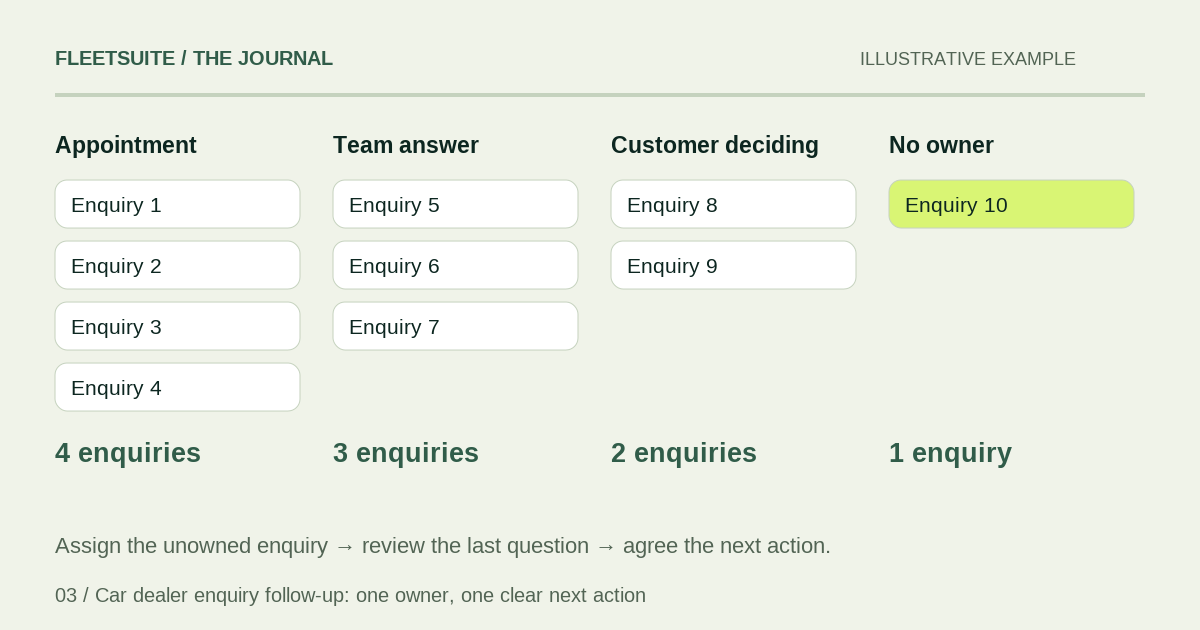
Illustrative example: a dealership reviews ten open enquiries at the start of the day. Four have appointments agreed, three await specific answers from the team, two await a customer decision and one has no named owner.
| Group | Count | Useful next action |
|---|---|---|
| Appointment agreed | 4 | Confirm vehicle readiness and agreed arrangements |
| Team owes an answer | 3 | Obtain the missing detail and meet the promised callback |
| Customer deciding | 2 | Respect the agreed next contact and record any response |
| No owner | 1 | Assign responsibility and inspect the last customer question |
The immediate ownership gap is one enquiry. The three unanswered questions are a different problem: they already have owners but may depend on preparation, valuation or another decision. Sending ten identical messages would not resolve either issue.
The dealer CRM workflow connects enquiries to stock, conversations and next steps. Use the queue to see what requires judgement today, not simply who has sent the most messages.
Preserve the customer’s context
A useful handover records the vehicle, intended use or important requirement, question outstanding, information already given and next promise. Distinguish the customer’s stated position from the salesperson’s interpretation.
For example: “Customer can visit after 16:00; asked whether the second key is supplied; workshop confirmation still outstanding.” That is more useful than “hot lead, call again”. If the vehicle becomes unavailable, offer another only after checking whether it meets the actual requirement.
| Vehicle | Customer’s question | Owner / backup | Next action | Promised callback |
|---|---|---|---|---|
| [Stock reference] | [Exact question still unanswered] | [Named owner / backup] | [Action and dependency] | [Agreed date, time and channel] |
Bring messages from supported channels into the working record without assuming every channel or provider is connected. The unified communications page explains the shared conversation approach. Avoid asking customers to repeat details that the team already holds appropriately.
Close outcomes and learn from missed promises
When an enquiry ends, record the outcome: sale, no suitable stock, timing, price, customer withdrawal or another specific reason. Preserve “unknown” where the reason was never established. Guessing why a customer went quiet creates misleading demand information.
Review missed callbacks and unresolved questions as well as response speed. Was the owner absent, was stock readiness unclear, or was the promised answer impossible to obtain by the stated time? Fix the cause before adding more reminders.
Agree follow-up with the customer and use your approved communication process. A useful response to an active enquiry should not be turned into an assumption of permission for unrelated promotional messages.
End the daily review with a short list: the answers owed, who owns them and when the customer expects them. That keeps the sales conversation connected to what your team can actually deliver.