
For a hire business, fleet utilisation measures how much of its vehicle capacity is on hire. A full Saturday diary and a quiet Tuesday can tell very different stories. Before adding vehicles, separate bookable gaps from maintenance and preparation time, then work out which empty days you could realistically fill.
How to calculate hire fleet utilisation
Choose a consistent unit for the review: whole vehicle-days for a first pass, or bookable hours if short hires matter to your business. Keep the same unit in the bookings, downtime and capacity totals. A van out for part of a day must not become both a full hired day and a full empty day.
Count fleet days first, then show planned and unplanned unavailability separately. It can be useful to calculate utilisation against bookable capacity, but removing workshop days from the denominator can make a troubled fleet look healthier. Keep the all-fleet view alongside it.
Use one location and one vehicle group at a time. Ten empty small vans do not solve demand for a vehicle with a tail lift. The availability and booking view is the relevant commercial starting point when you need bookings and readiness together.
Read one week three ways
Fleet utilisation (%) = on-hire vehicle-days ÷ total fleet vehicle-days × 100. For a separate bookable-capacity view, divide by total fleet days less unavailable days. Label both measures so a reduction in available capacity cannot hide rising downtime.
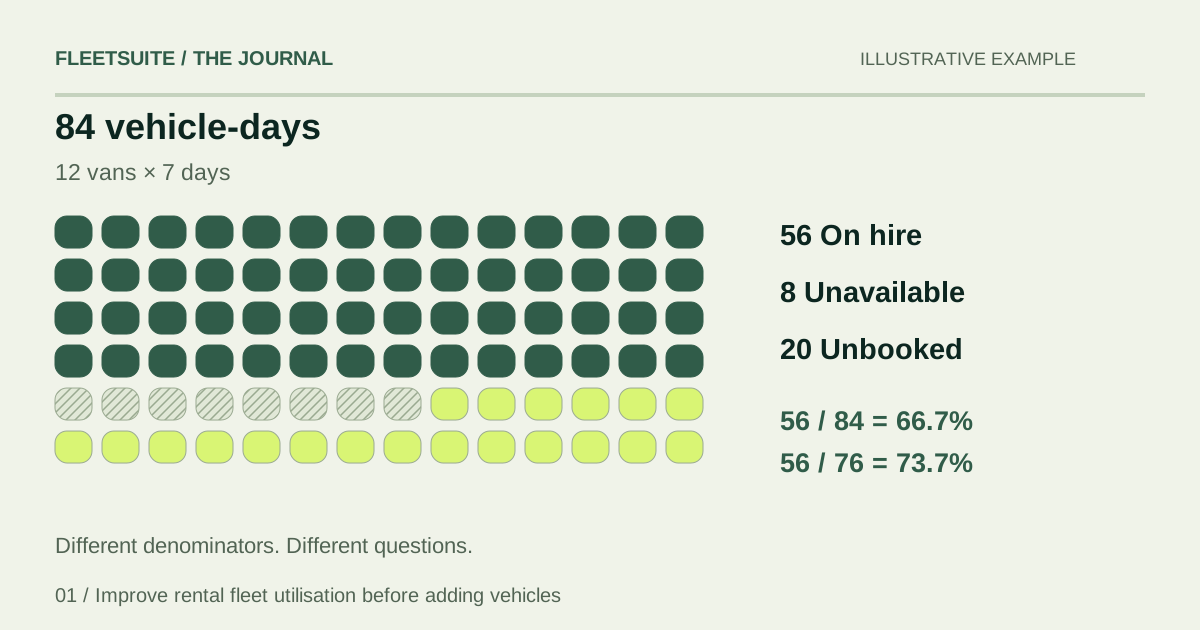
Illustrative example: an independent depot operates 12 vans across a seven-day review period. Each van-day is placed in exactly one category. These are invented planning figures, not a FleetSuite customer result.
| Measure | Vehicle-days |
|---|---|
| Total fleet capacity: 12 × 7 | 84 |
| On hire | 56 |
| Unavailable for maintenance or preparation | 8 |
| Available but unbooked | 20 |
Fleet utilisation is 56 ÷ 84 = 66.7%, rounded to one decimal place. Against the 76 bookable days, it is 73.7%. Both are valid descriptions of these inputs; neither explains the 20 empty days on its own.
Look at those 20 days by vehicle and time. Suppose six are isolated gaps between hires, eight are quiet midweek days and six are on a vehicle class that customers rarely request. Those three problems need different responses.
Give each gap a reason and an owner
- Isolated gaps: check whether collection times, return buffers or minimum hire periods leave a usable opening. Preserve cleaning and inspection time.
- Quiet days: compare enquiries with actual availability. Few enquiries suggest a demand question; rejected enquiries suggest a matching or timing question.
- Wrong vehicle mix: record the specification requested and why the available vehicle was unsuitable. Do not treat every declined alternative as a price objection.
- Unavailability: distinguish work in progress from a vehicle waiting for parts, approval or a readiness check. Assign the next action to a person.
A short lost-enquiry log is enough to begin: requested dates, vehicle need, option offered, result and reason. Include enquiries you could not fulfil. Looking only at completed hires hides unmet demand.
When unavailable days are the issue, review the next workshop action alongside the hire diary. The service scheduling workflow helps connect planned work to the bookings the vehicle needs to fulfil.
Try one change, then inspect the result
If a shorter hire genuinely fits four of the isolated days, test that offer on those gaps. If all four become paid hired days without displacing existing work, the example rises to 60 ÷ 84 = 71.4%. That is a scenario, not a promised improvement. Check revenue, preparation effort, mileage and any extra costs as well as the percentage.
Agree the test period and a stopping condition before changing the offer. If extra turnarounds overload the desk or workshop, a higher utilisation figure may leave the business worse off. Never count a request as a confirmed booking or a booking as collected revenue.
At the next weekly review, decide whether the evidence supports a booking-rule change, a readiness improvement, a different vehicle mix or additional capacity. The useful output is a named next action, with the reason behind it.