
There is no universal age or mileage at which every fleet vehicle should be replaced. Compare feasible options over the same future period, then test the repair, downtime and resale assumptions that could change the answer. An expensive repair estimate or a long history of money spent cannot decide the next move on its own.
Which factors should decide fleet vehicle replacement?
Choose a common end date and a comparable job for the vehicle: the same capacity, expected use and service standard. If a replacement offers materially different capability, explain that difference before comparing its numbers.
Resolve safety and fitness-for-purpose first. A low forecast cost cannot make an unsafe option acceptable. Then identify feasible choices: repair and retain, replace, or reduce capacity if the work can genuinely be covered another way.
Past acquisition and repair costs explain the history, but they are already incurred. Use them to assess reliability and forecast quality; do not add them again as future costs. The vehicle lifecycle worksheet is useful for the complete ownership view and keeps that separate from the next decision.
Compare the same next twelve months
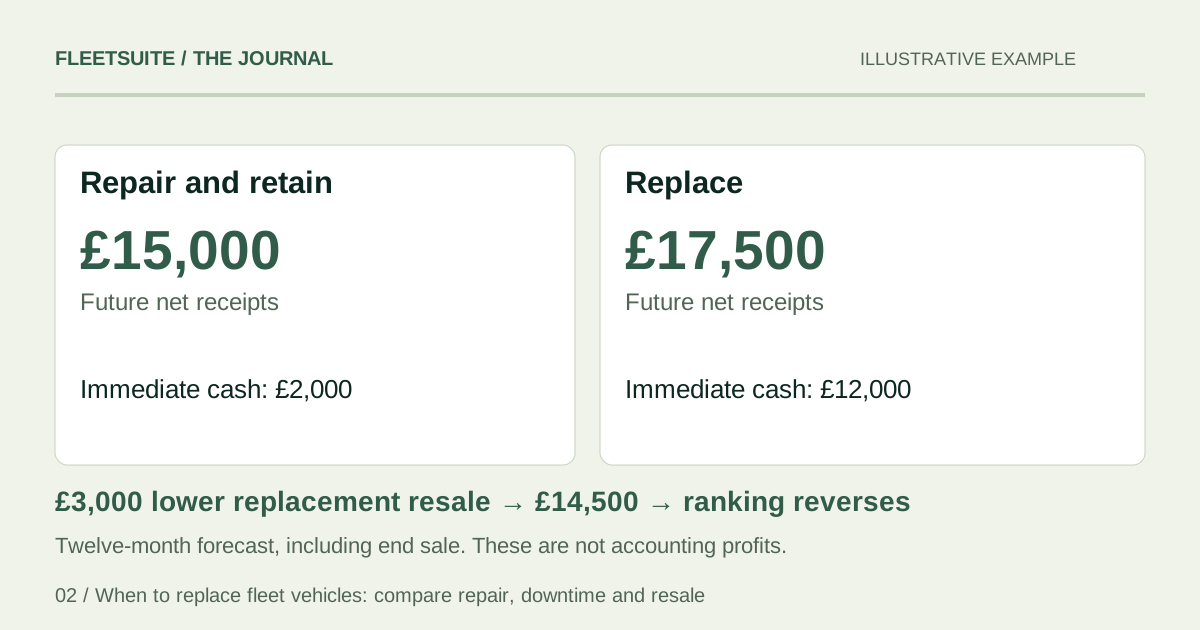
Illustrative example: a van can be sold today for a net £8,000, after immediate disposal costs. All figures below use a consistent simplified basis, before business taxes, finance and common overheads. Forecast hire income is already reduced for expected downtime, so no separate lost-income charge is added.
| Item | Repair and retain | Replace |
|---|---|---|
| Forecast operating income | £18,000 | £19,000 |
| Immediate repair | −£2,000 | £0 |
| Replacement purchase | £0 | −£20,000 |
| Sell current van now, net | £0 | £8,000 |
| Other forecast operating costs | −£7,000 | −£5,500 |
| Net vehicle sale value at end | £6,000 | £16,000 |
| Future receipts less payments, including end sale | £15,000 | £17,500 |
On these inputs, replacement is ahead by £2,500 over the period, including an assumed sale at the end. These totals are a simplified future receipts-less-payments comparison, not accounting profit or a valuation. The existing van’s current value is recognised through the option to sell it now; it is not added again as income to the retain option.
Replacement also needs £12,000 for the purchase after selling the current van, compared with the £2,000 immediate repair. That cash requirement may affect feasibility even where the forecast comparison favours replacement. Check actual finance settlement, terms and timing separately.
Test the figures that could reverse the answer
If the replacement’s end sale proceeds are £3,000 lower, its result becomes £14,500 and it falls £500 behind the retain option. That single change reverses the example. A confident decision therefore needs a credible resale assumption, not just a precise total.
Challenge the expected downtime, further repairs, income and operating costs as well. Do not both reduce income for unavailable days and charge the same lost income again. Do not include depreciation as another cost when purchase and final resale already capture the value change in this comparison.
For a longer or more complex decision, the timing of cash flows, finance, tax and business-specific costs may need a fuller assessment. Record excluded items and obtain the appropriate accounting input rather than treating this simplified example as a complete investment appraisal.
Make the decision inspectable
Save the options considered, inputs, assumptions, chosen action and review date. Separate a repair estimate from an approved invoice and an expected sale value from actual proceeds. If a major assumption changes before you act, reopen the comparison.
Use maintenance cost records to improve the evidence on repairs and downtime. The decision should reflect the vehicle’s future role and the reliability of the forecast, while preserving a clear account of what happened before.