
Reducing avoidable service downtime starts with four inputs: the maintenance requirement, current readings, expected use and a realistic workshop window. A date in the diary only works if the vehicle can reach it within its requirements and the whole period out of service fits the plan.
Start with the actual requirement
Confirm the relevant date, mileage limit and other conditions for the vehicle and task. Use its manufacturer information and applicable inspection or maintenance requirements. Do not turn a convenient booking slot into a reason to extend a requirement.
Use current readings with their recorded dates. A mileage figure from last month is a weak basis for next week’s plan. Where mileage comes from another source, check when it was updated and whether it uses the same unit.
The vehicle handbook is a starting point for servicing information, as described in GOV.UK’s vehicle safety guidance. Safety concerns need assessment when they arise, independently of a planned service window.
Use mileage and expected use to choose a service window
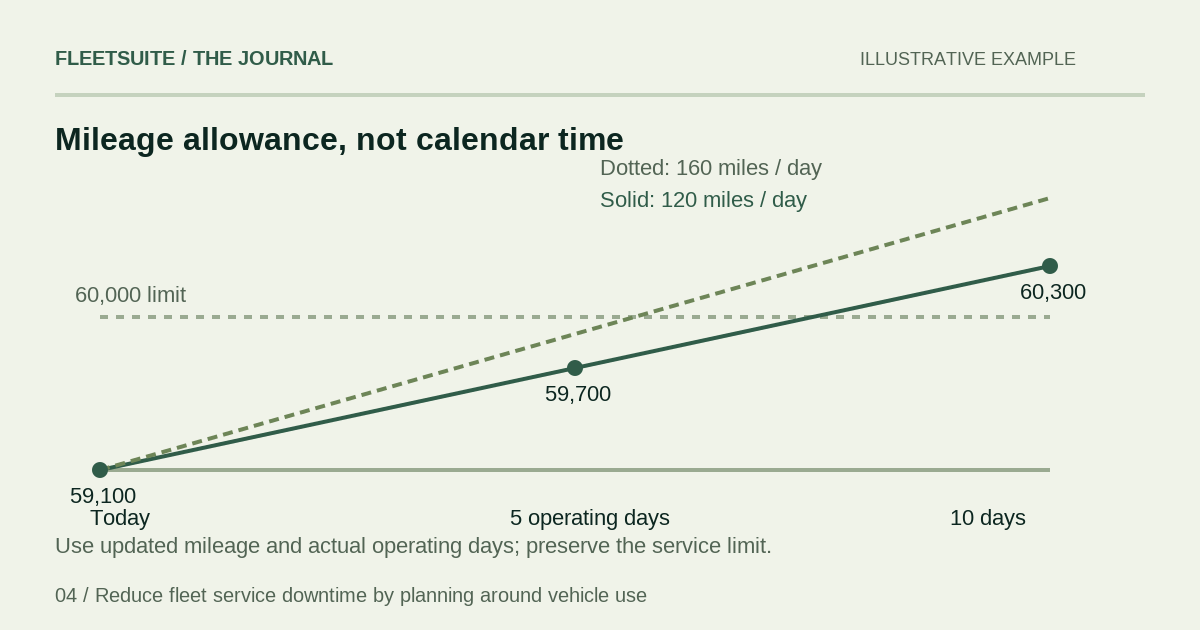
Illustrative example: a van is at 59,100 miles and its next service is required by 60,000 miles or in 14 days, whichever comes first. It has 900 miles remaining. At an assumed 120 miles on each operating day, that allowance covers 7.5 operating days.
If there are ten planned operating days before the proposed workshop visit, projected mileage is 60,300. That slot is too late on these assumptions, even though it falls before the calendar deadline. Choose an earlier workable slot or change the vehicle’s allocation within the applicable limits.
| Input or check | Value |
|---|---|
| Current mileage | 59,100 |
| Mileage limit | 60,000 |
| Remaining allowance | 900 miles |
| Expected daily use | 120 miles per operating day |
| After ten operating days | 60,300 miles |
| After five operating days | 59,700 miles |
A slot after five operating days leaves 300 miles on the baseline forecast. If daily use rises to 160 miles, the same five days leave only 100 miles. Neither margin is a safety recommendation; both show why the usage assumption and the actual readings need review.
Plan the whole period out of service
Ask the workshop what the booking covers, likely duration, parts preparation and how additional work will be handled. Add time for travel, inspection and release as appropriate. A two-hour job on an estimate does not necessarily mean the vehicle is unavailable for only two hours.
Check the bookings or operating work on either side. Do not promise a collection immediately after an optimistic completion time. Agree who updates availability if work runs late and who decides on an alternative vehicle.
The service scheduling workflow connects due work with vehicle commitments. For a simple starting record, use the maintenance schedule template and keep the source requirement alongside it.
Refresh the plan when use changes
Review the readings as the slot approaches, especially after a longer trip or changed allocation. Recalculate from the new position rather than continuing to use the old average. If a requirement can no longer be met by the plan, resolve the vehicle’s use and workshop arrangement before it becomes overdue.
After completion, record the actual work, date, mileage, findings and next requirement. Compare planned downtime with actual downtime to improve the next booking, without using a previous quick visit as a guarantee.
Data-led timing means choosing a better window within the requirements. It does not mean allowing a forecast to overrule a safety issue, a service limit or competent technical judgement.